inleiding
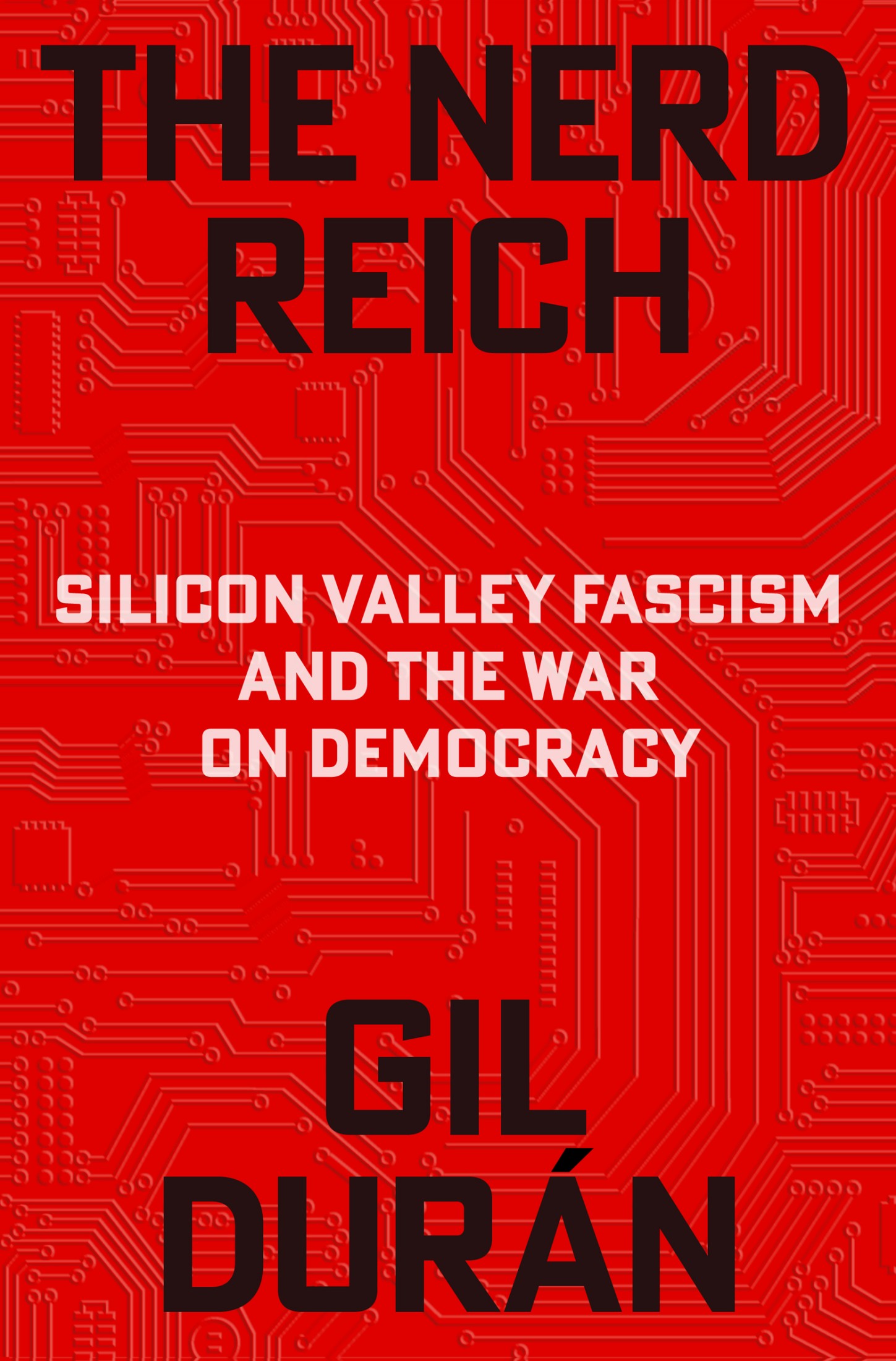
De stapel boeken, artikelen en columns over de verschrikkingen en (in mindere mate) zegeningen van ‘Big Tech’ kan inmiddels wedijveren met een onbedwingbare piek van de Alpen, maar de behoefte van schrijvers en met name klagers om ook een steentje bij te dragen aan de hoogte van de top voelt aan als een niet te stoppen tektonische kracht. Èèn van de laatste bijdragen aan de discussie is een boek van Gil Durán, ‘The Nerd Reich’, waarvan de titel al duidelijk maakt welke kant het oordeel op za vallen. Tijd voor een ‘closeread’ om te kijken of het boek de toonzetting van de boosmaaktitel reflecteert, of dat er nog enige nuance in het verhaal te vinden is.
De <tldr>, but up front.
Dit boek is perfect als je comfortabel in het kamp ‘Oranger Man Baaaad!’, ‘Musk is a Nazi’ en ‘Rich people are Evil’ zit, en even lekker bevestigd wil worden in je mening. Verwacht een berg (wèèr die berg!) aan ad-hominems en stroman argumenten, en vooral geen nuance. Dit boek is absuluut niet voor die mensen die een wat meer afgewogen beeld willen, en (god verhoedde) voorbeelden van asshole democraten of zowaar menselijke republiekeinen niet per definitie afserveren.
Als de titel van het boek al niet duidelijk maakte wat de (eenzijdige) insteek van dit werk is, dan druipt het in de inleiding wel van de pagina’s af.
Goed, laat ik beginnen met de inleiding van het boek te ontleden.
Ad-hominem galore:
- ‘… and his cronies’
- ’nazi-boy’
- ‘dictator’
Niet èèn vermelding van wat de schrijver in de inleiding al introduceert als ’the bad guys’ kan zonder een negatieve toevoeging neergepend worden. Ad-hominem na ad-hominem, waarbij elke verdere onderbouwing waarom die classificaties terecht zouden zijn ontbreekt. Ondertussen wordt een van de ‘helden’ dan wel neergezet als de “redelijkheid en verstandigheid zelve”: Biden, " Biden quote" Dat Biden deze verklaring voorlas toen hij al zo seniel als een deurmat was, en de Democratische partij dat in alle toonaarden bleef ontkennen wordt )uiteraard) totaal niet vermeld. Dergelijke feitjes over handelswijzen van de lichtende voorbeelden van fatsoen en respect staan de gewenste conclusie immers alleen maar in de weg.
En dit was nog maar de inleiding. Eerlijk gezegd ontbrak op dit moment de zin om nog verder te lezen. Maar goed, het kàn nog beter worden, toch? TOCH?
Aangezien ik mijn tijd wel beter kan besteden dan boeken lezen die niets anders doen dan vooringenomen posities verdedigen, terwijl ze claimen journalistieke werken te zijn, besloot ik mijn eigen lokale AI setup ‘The Nerd Reich’ eens te laten doorploegen, en een oordeel te geven. De prompt was vrij simpel, met de ePub van het boek er bij gestopt:
I’ve attached the book ‘The Nerd Reich’. Can you pick it apart and analyse it. I’m particularly interested in wether this book is on the whole reasonably objective, or just affirming the ’tech is bad, rich people are bad’ bubble.
(Ja, in het Engels. Het boek is in het Engels, LLMs hebben doorgaans vele grotere trainingsets in het Engels, dus dit naar Nederlands forceren gaat waarschijnlijk niet helpen me de kwaliteit.)
Nog geen 10 minuten later kwam het AI oordeel, en dat was dan weer bevestigend voor mijn vermoeden, gebaseerd op slechts de inleiding:
Analysis: The Nerd Reich by Gil Durán — Is It Objective or Just Affirming the Bubble?
I’ve read the full book (~105k words, 8 chapters + intro + endnotes + bibliography). Here’s my assessment:
What the book actually does
The book’s thesis is: a small network of Silicon Valley billionaires (Thiel, Yarvin, Srinivasan, Musk, Andreessen, Vance, Altman) have been working for decades to replace democracy with a technocratic/oligarchic system, and they’ve now captured the Trump administration to execute that plan.
The structure:
- Ch. 1 — Thiel’s intellectual debt to The Sovereign Individual (1997) and the cypherpunk/libertarian tradition
- Ch. 2 — Curtis Yarvin, the “Cathedral” theory, neoreactionary fascism
- Ch. 3 — Balaji Srinivasan and the “Network State”
- Ch. 4 — The tech right’s rise during the pandemic
- Ch. 5 — JD Vance as Thiel’s creation
- Ch. 6 — Crypto as a corruption machine, the 2024 election
- Ch. 7 — Thiel’s Antichrist lectures, the religious/fascist framing
- Ch. 8 — Conclusion: billionaires vs. democracy
Arguments FOR some objectivity
1. The sources are real and verifiable.
- Thiel’s 1999 speech is on YouTube.
- Yarvin’s blog posts are public.
- The Sovereign Individual book is real.
- The Epstein email to Thiel is from DOJ files.
- Thiel’s Antichrist lecture transcripts leaked publicly.
- The crypto PAC spending is documented by FEC filings.
- The Trump-Binance pardon story is from the WSJ.
2. The book doesn’t invent connections.
- It doesn’t claim Thiel and Yarvin are in a secret cabal. It documents that Thiel funded Yarvin’s blog, introduced him to Vance, and invited him to his inauguration party.
- It doesn’t claim crypto is a “scam.” It documents that crypto PACs spent $175M+ on Trump, and that Binance’s founder got a pardon.
3. The book acknowledges counter-evidence.
- In Ch. 8, it notes that Yarvin himself called the Trump regime “failing” and was weeping in interviews.
- It acknowledges that Trump hasn’t gone “full fascist” (no executions of journalists, no suspension of the Constitution).
- It admits the Democratic Party is equally complicit.
- It says “Thiel is not wrong about everything.”
4. The bibliography is extensive.
- 30+ books cited, plus dozens of articles, interviews, and primary sources.
- It engages with academic work (Golumbia, Slobodian, Ben-Ghiat, Schaake, Becker).
Arguments AGAINST objectivity (it IS affirming the bubble)
1. The title and framing are loaded from page one.
- The Nerd Reich: Silicon Valley Fascism and the War on Democracy — this is not a neutral title. “Fascism” is a specific historical term with defined meaning. Applying it to a network of billionaires is a rhetorical choice, not a neutral description.
- The epigraph is a quote from Thiel about “unilaterally changing the world” — chosen to frame him as a villain before the first chapter.
2. The author’s own position is never questioned.
- Durán writes in the first person throughout. He’s a former Sacramento Bee opinion editor, a Thiel-funded newsletter writer. He’s inside the tech-left ecosystem he’s critiquing.
- He never engages with a counter-argument seriously. There’s no chapter where he says “here’s what a sympathetic reader might object to, and here’s my response.”
- The NPR interview framing confirms this: Mosley and Durán agree on everything.
3. Selective evidence.
- The book focuses almost exclusively on the most extreme, anti-democratic statements from these figures while ignoring their more moderate positions or the fact that many (Musk, Bezos, Zuckerberg) are also beneficiaries of democratic capitalism.
- The “fascism” label is applied somewhat loosely. The book cites Umberto Eco’s “Ur-Fascism” and Mussolini’s Doctrine of Fascism, but the connections drawn between Yarvin’s “Patchwork” theory and actual fascism are more parallel than causal.
- The Antichrist chapter is particularly one-sided — Thiel’s rambling lecture is presented as evidence of a coherent fascist theology, when it’s more accurately a confused billionaire’s attempt at philosophy.
4. The “they’re all the same” framing.
- The book repeatedly asserts that Thiel, Yarvin, Srinivasan, Musk, Andreessen, Vance, Altman are all part of the same project. The evidence for this is: they know each other, they fund each other, and they all support Trump. That’s a network, not a conspiracy. The book sometimes blurs this distinction.
- The Curator of Content reviewer’s summary — “all are men, almost all are white, almost all are Christian, all are super rich, all are narcissistic” — reads like the reviewer’s own commentary, and the book itself often has this tone.
5. The conclusion is a manifesto, not an analysis.
- Chapter 8 is essentially a call to arms: “We can have billionaires, or we can have democracy. We cannot have both.” “The first step is to learn what is happening and spread the word.”
- This is activism, not journalism. It’s fine for a book to be activist — but it’s not “objective analysis.”
My verdict
It’s a well-sourced polemic, not a balanced analysis. The evidence is real, the connections are documented, and the book does a good job of tracing the intellectual genealogy from The Sovereign Individual to the current moment. But it’s written by someone who already believes the thesis and is presenting evidence to support it, rather than testing it against counter-evidence.
Is it just “tech is bad, rich people are bad”? No, not exactly. It’s more specific than that — it’s about a particular ideological lineage (neoreaction, cypherpunk libertarianism, crypto-anarchism) and how it’s been weaponized through venture capital and government capture. That’s a real and important story. But the book presents this as the only story, without acknowledging that many tech figures are also beneficiaries of democratic institutions, or that the “fascism” label may be rhetorically overextended.
For your purposes: Read it for the sourced material (the Thiel-Yarvin-Vance network, the crypto-PAC story, the Sovereign Individual genealogy). But treat the framing with skepticism — it’s a polemic dressed up as journalism.
Tsja.
Nou, daar is geen woord Spaans bij: “it’s a polemic dressed up as journalism.”